
In Halo: Reach, you can activate Night Vision, which turns the game world into a green, monochromatic image.
This is not just a visual effect — it creates an experience surprisingly close to what Polar Bear Helps does.
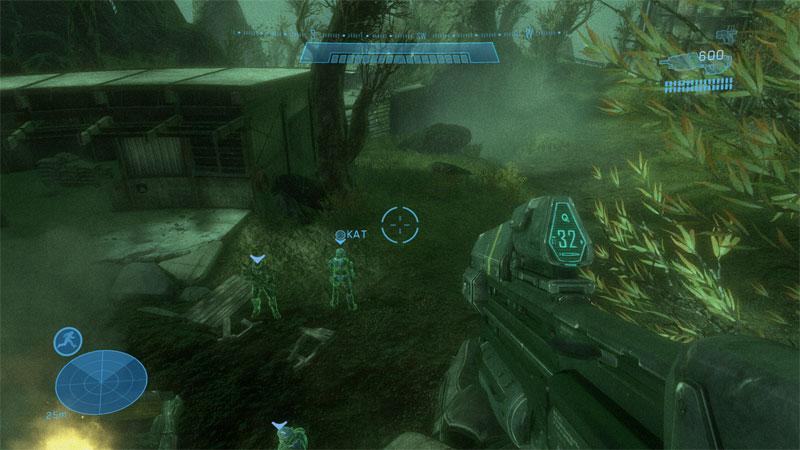
Halo: Reach in Night Vision mode — an example of how green monochromaticity changes the perception of the game and brings it closer to the Digital Bridge idea.
When NV is active:
- colors disappear,
- the world becomes less stimulating,
- the green tint calms the mind,
- and the game becomes tiring more quickly.
This is exactly the same principle used by Digital Bridge:
green monochromaticity reduces stimulation and helps the player gently return to the real world.
Halo: Reach turns out to be much closer to the Polar Bear Helps philosophy than one might expect.
Games that allow Night Vision on demand
Night Vision appears mainly in tactical and military games, where it serves a functional purpose rather than a decorative one.
Here are the most notable titles where NV can be activated manually:
Tactical and military shooters:
- Tom Clancy’s Ghost Recon
- Crysis
- Metal Gear Solid V: The Phantom Pain
- Ground Branch
- S.T.A.L.K.E.R. GAMMA
- Battlefield 3
- Contractors (VR)
Horror and survival:
- Left 4 Dead
- SCP: Containment Breach
- Arrogation: Unlight of Day
Other genres (rare):
- Nightvision: Drive Forever
Why Night Vision appears almost exclusively in shooters
Night Vision is a tactical tool, not an aesthetic effect.
- Shooters often take place in dark environments where NV makes sense.
- NV provides tactical advantage — seeing in the dark, planning movement.
- In other genres, NV adds nothing to gameplay.
- It requires specific shaders and lighting setups that naturally fit military games.
This is why NV is mostly found in shooters — there it serves a purpose, not just a visual flourish.
A vision for the future: one Polar Bear Helps-inspired filter in game engines
I would like to see future game engines include a single filter inspired by Polar Bear Helps:
Green monochromaticity.
One unified effect that combines:
- reduced visual stimulation,
- a calming green tint,
- a gentle lowering of arousal,
- a natural soft landing after long play sessions.
Such a filter could activate automatically after extended gameplay — a subtle, healthy transition back to the real world.
A practical implementation of the Digital Bridge concept.
Dodaj komentarz